
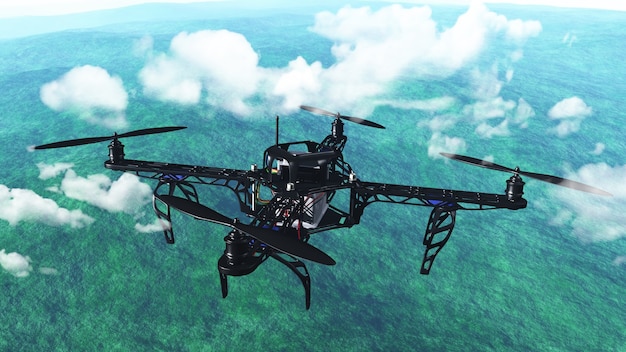
In recent years, drone technology has advanced in leaps and bounds, unlocking new possibilities across various sectors. These unmanned aerial vehicles (UAVs) have emerged as game-changers, introducing a level of precision, speed, and efficiency previously unimaginable. From agriculture to urban planning, drones are transforming industries by offering innovative solutions that improve productivity and enhance data collection. One of the most remarkable advancements has been the innovation in aerial data capture, a breakthrough that is reshaping the way we perceive and interact with our world.
Revolutionizing Data Capture
Traditional methods of data collection, especially in challenging or inaccessible areas, have always been time-consuming and costly. Whether it’s mapping vast landscapes, conducting surveys, or monitoring environmental changes, gathering accurate data has often involved cumbersome fieldwork or satellite imagery. However, with the rise of drones, innovation in aerial data capture has enabled scientists, engineers, and businesses to obtain high-resolution, real-time information with remarkable ease.
Drones are now equipped with an array of sophisticated sensors, cameras, and mapping tools that allow for detailed, accurate data collection. This leap in technology has opened up a world of possibilities. For instance, drones can be used to create highly detailed 3D models of terrains, conduct thermal imaging, or monitor environmental conditions in real time. The versatility of drones is unprecedented, and industries that once relied on expensive and labor-intensive methods are now able to gather data with speed and precision that were previously unattainable.
Expanding Industries through Drone Solutions
The influence of drones spans numerous industries, offering revolutionary solutions that have dramatically expanded capabilities and improved efficiencies. One of the key drivers of this transformation is the ability of drones to provide faster and more cost-effective alternatives to traditional practices. Industries such as agriculture, construction, logistics, and energy have been quick to integrate drone technology into their operations, unlocking new potential for growth and innovation.
In agriculture, drones are used to monitor crops, assess soil conditions, and track irrigation systems. This has allowed farmers to gain critical insights into the health of their crops, optimize resource usage, and improve yields. In construction, drones assist with site inspections, creating accurate topographic maps and monitoring the progress of projects. As a result, companies can ensure projects are completed on time, with fewer errors and more streamlined workflows.
Furthermore, drones have also made significant strides in the energy sector, particularly in the inspection of power lines and wind turbines. The ability to carry out remote inspections in hard-to-reach areas, without the need for workers to scale towers or travel to remote locations, has not only saved time but has also increased safety and lowered operational costs.
The integration of drones into various industries has not only increased efficiency but has also sparked a wave of new business opportunities. From companies offering drone data services to startups focusing on developing next-generation drone solutions, the market for drones is experiencing an incredible surge. As technology continues to evolve, we can expect to see drones being incorporated into even more sectors, continuing to expand industries through drone solutions.
The Automation of Remote Sensing Tasks
One of the most exciting prospects of drone technology is the ability to automate remote sensing tasks. Traditionally, remote sensing tasks, such as surveying, monitoring weather patterns, and environmental observations, required a combination of satellite imagery, manual labor, and complex analysis. Drones, however, have the potential to completely automate these processes, significantly reducing the need for human intervention and accelerating data collection.
Equipped with autonomous flight systems, drones can follow predetermined flight paths, gather data, and return to base without the need for a human pilot. This level of automation is particularly valuable for tasks that require frequent monitoring, such as agriculture, environmental conservation, and disaster management. Drones can autonomously collect data over large areas, providing real-time insights that are critical for decision-making.
For example, in the case of agricultural monitoring, drones can fly over fields at regular intervals, automatically capturing images, thermal data, and other relevant metrics. The data collected is then analyzed and presented in a digestible format, allowing farmers to respond swiftly to any issues. This automation of remote sensing tasks not only increases efficiency but also ensures that data is consistently collected, improving the accuracy of the analysis and the effectiveness of interventions.
New Applications in Agriculture and Urban Planning
Drone technology is paving the way for new applications in industries such as agriculture and urban planning, offering solutions that were once considered the stuff of science fiction. In agriculture, drones have revolutionized precision farming, allowing farmers to monitor crop health, optimize irrigation, and manage pest control with unprecedented accuracy. Through advanced aerial mapping and multispectral imaging, drones can detect subtle changes in plant health, providing farmers with real-time insights that help them make informed decisions about when to irrigate, fertilize, or harvest.
This level of precision also has significant environmental benefits, as it enables farmers to reduce water and pesticide usage, promoting sustainable practices. Drones can even be used to plant seeds in hard-to-reach areas, a method that’s being tested for reforestation projects in remote regions. The ability to monitor vast expanses of farmland with ease and efficiency makes drones an indispensable tool in the pursuit of sustainable agriculture.
In urban planning, drones are increasingly being used to map out cities, monitor traffic patterns, and assess infrastructure needs. By capturing high-resolution images of cities from above, planners can analyze traffic flow, identify potential areas for development, and monitor the condition of roads and buildings. This data-driven approach allows urban planners to create smarter, more sustainable cities, with better infrastructure and more efficient use of resources. The ability to access accurate, real-time data about urban environments is transforming how cities are designed and maintained.
Conclusion
The rapid evolution of drone technology is unlocking new possibilities across a variety of industries, offering innovative solutions that enhance productivity and improve data accuracy. From innovation in aerial data capture to new applications in agriculture and urban planning, drones are revolutionizing the way we approach tasks that once required significant time, resources, and manpower. As the technology continues to advance, we can expect to see even more applications emerge, allowing drones to become an indispensable tool in shaping the future of numerous industries. Whether it’s automating remote sensing tasks or expanding industries through drone solutions, the potential for drones to revolutionize the way we work is limitless.


More Stories
Exploring Drone Technology: A Comprehensive Guide
Soar Into the Future: How Drones Are Revolutionizing Tech, Business, and Beyond
Unleashing the Sky: How Autonomous Drones Are Revolutionizing Our World